
Furniture Disassembly and Assembly in Najran — Get Furniture Ready to Move
Some pieces do not pass entrances assembled, and some get damaged if moved whole. We explain what disassembly and assembly really involve, which risks to avoid, and what to clarify before you inquire.
- Fittings kept organised
- Pieces assessed before taking apart
- Stability checked after assembly

What information is needed to decide whether furniture can be taken apart and rebuilt?
Not every piece can be disassembled and rebuilt with equal ease. Ready-to-assemble furniture designed with removable joints differs from a wooden piece fixed with glue or a special fastening system. Feasibility depends on the type of joints, the condition of the piece and how many times it has been taken apart before.
That is why we ask for the piece type, photos if possible, how many pieces, the brand or model if known, and whether the work is part of a move or on-site. We then assess what can be done and confirm the service and availability.
- Furniture type and number of pieces
- Clear photos of the piece and its joints
- Brand or model if known
- Whether you need disassembly, assembly or both
- Part of a move, or on the same site
What do disassembly and assembly include?
General stages; details vary by piece.
Identify which pieces can be taken apart
Each piece is considered: does it have removable joints, and does taking it apart help the move or risk damage? Some pieces are better moved whole.
Review the design
The way a piece is assembled is checked before any disassembly: visible or hidden screws, wooden or metal joints, and whether a manual or manufacturer photos exist.
Use suitable tools
The wrong tool strips screw heads and openings and makes reassembly harder; each joint type has its tool.
Organise fittings
Screws, bolts and hinges go in labelled bags or trays per piece and travel with that piece.
Protect the parts
Panels and doors are covered at the edges and not stacked without separators so they arrive intact.
Reassemble
Parts are assembled in a suitable order with attention to holes and alignment, never forcing a part that does not match.
Check stability
After assembly the piece is checked for stability and for doors and drawers working, because unstable assembly can cause injury or damage.
Why fittings are organised from the first removal
What most delays reassembly is not a hard piece but lost or mixed screws. So fittings are divided by unit: door, shelf, base, back.
Dividing them saves much time during assembly and reduces the chance of using a wrong screw that weakens a joint.
Furniture categories commonly requested
Beds
Wooden or metal frames with varied joints; slats and supports must be checked on reassembly.
Wardrobes
Large units with hinged or sliding doors and internal shelves; need protection for doors and mirrors and full emptying.
Cabinets and bookcases
Can be heavy and rely on a thin back panel, so taking the back off and refitting needs care.
Shelving
Often easy to take apart, but wall fixing points are reviewed before reassembly.
Office furniture
Desks, filing units and workstation systems, requiring organisation of similar parts.
Children's furniture
Bunk beds and small desks need extra attention to secure fixing for safe use.
Situations where disassembly before a move helps
Disassembly helps when an entrance, corridor or elevator is narrower than the piece, when the piece size risks collisions in carrying, when load size inside the vehicle must be reduced, or to protect fragile parts such as mirrors and glass doors.
On the other hand, we do not advise taking apart pieces designed to stay assembled; doing so and rebuilding may weaken their joints. This is where assessment comes before the decision.
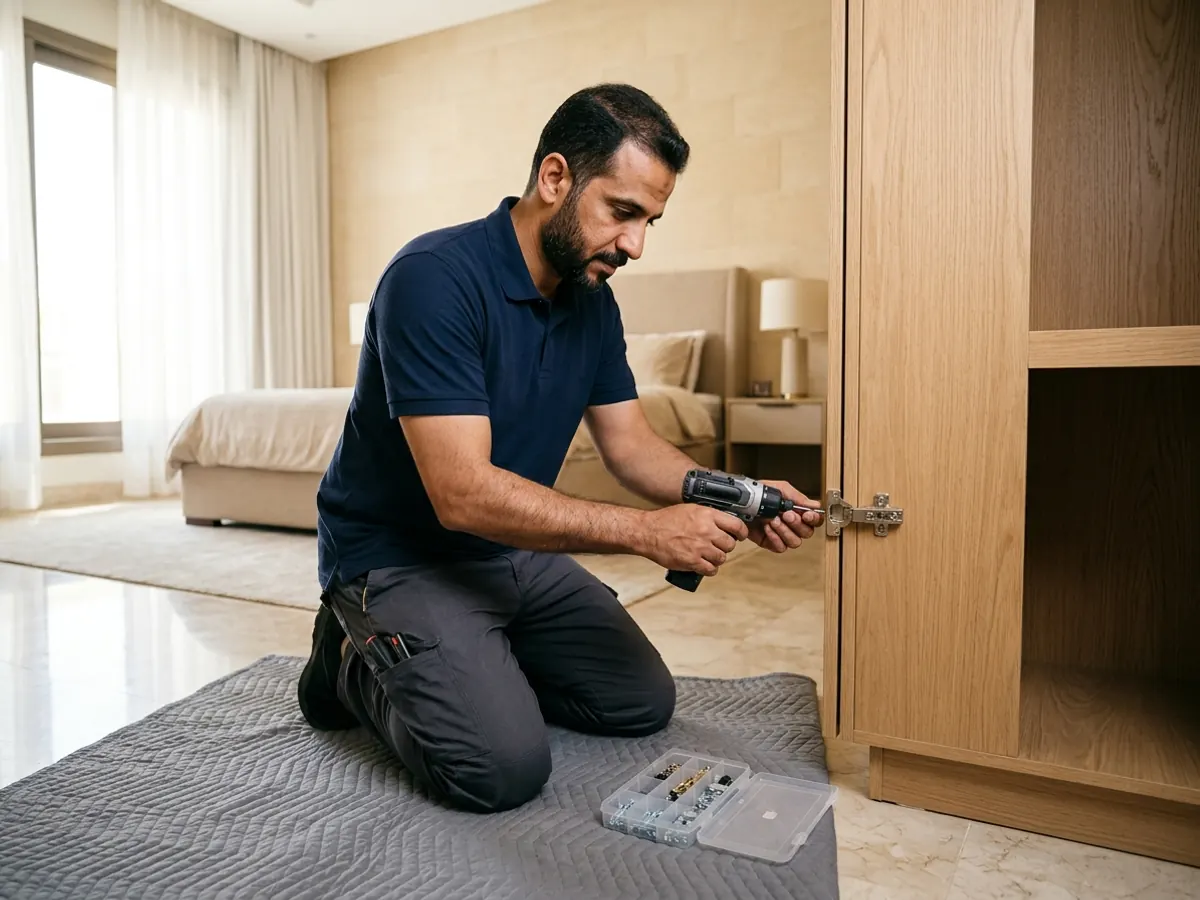
What can happen if disassembly is not done carefully?
General awareness information, not a warning about any specific piece.
- Lost or mixed screws and fittings
- Stripped threaded joints or misaligned fixing holes
- Parts that no longer match when panels of similar pieces are mixed
- Unstable assembly that weakens furniture or endangers children
What to clarify before sending a request
About the piece
- Furniture type and number of pieces
- Photos from several angles and a close-up of joints
- Approximate dimensions
- Brand or model if available
About the service
- Whether you need disassembly, assembly or both
- Whether it is part of a move or on the same site
- Whether assembly guides or original fittings are available
- Service location and preferred date
Ready to describe the pieces?
Send the type, number and photos so we can assess assembly feasibility.
Scope boundaries
May be part of an agreement
- Taking apart disassemblable furniture and organising its fittings
- Reassembly on the same site or at the new site
- Checking stability after assembly
- Protecting disassembled parts during a move when agreed
Not assumed
- Electrical and plumbing work or lighting connections
- Removing or installing air conditioners
- Repairing damaged pieces or fabricating missing parts
- Keeping a manufacturer warranty valid after disassembly (not promised)
What affects the cost of assembly work?
There is no fixed price covering all furniture because pieces differ in complexity.
- Number of pieces
- Each piece takes time to take apart and again to rebuild.
- Design complexity
- Hidden joints and complex systems need more time and tools.
- Furniture type
- Large wardrobes and full bedrooms are more complex than simple shelves.
- Work duration
- Affected by size, number of parts and alignment effort.
- Piece condition
- Old or damaged pieces may need extra caution.
- Move requirements
- An associated move, or taking apart at one site and rebuilding at another.
Get a quote after sending the details of the service you need.
Request assembly details
A delivery address is only asked for when the work is part of a move to another location.
Frequently asked questions about furniture assembly
Can all types of furniture be taken apart?
No. Some pieces are designed to remain assembled and taking them apart may weaken their joints. We assess each piece first and tell you if moving it whole is better.
Why does knowing the furniture type matter?
The type and brand determine the joints, tools and assembly guide. Ready-to-assemble furniture is generally designed to be disassembled, while furniture made with fixed joints needs more care.
How are screws and fittings organised?
In labelled bags or trays per unit (door, shelf, base), kept with the piece itself. This reduces lost parts and speeds up reassembly.
Is assembly a standalone service?
It may be requested on its own or as part of a move, and either depends on availability and confirmation. State which you want in your request.
What affects the cost?
Number of pieces, design complexity, furniture type, duration, condition and any associated move. We do not quote a figure before reviewing your request.
Request assembly details
Send the furniture type and photos so we can review what can be done.
Helpful guides before you enquire
- Disassembling furniture before movingWhen does furniture need taking apart before a move, and when should it stay assembled? A decision based on measuring and the type of piece, how to keep screws and parts, and what to leave to a specialist.
- Post-move inspection checklistA tickable, printable post-move inspection checklist: verifying furniture and carton counts, checking mirrors and wooden corners, and testing reassembled wardrobes and beds.
- Preparing furniture for movingHow to prepare furniture for a move: a simple timeline, measuring doors and elevators, the disassembly decision, box weight and labelling, and a bag of essentials, plus common mistakes.