
Fragile Furniture Moving in Najran — Preparation and Protection
A single glass top or polished wood surface can be hurt by one knock or slip. This page is about assessing material, size and weak points before protection is chosen, and then sending the piece details for review.
- Material and size assessment
- Glass and mirrors
- Protection matched to each piece

What factors affect how fragile furniture is protected?
Protection is set by four things: the piece’s material, its dimensions, its weak points such as edges and corners, and the conditions of the move including loading, securing and delivery. Material matters most: glass cracks under pressure, polished wood scratches from friction, and marble is heavy and brittle at its edges.
Nothing requested here is a promise that damage cannot occur; protection lowers the risk and does not remove it. What is offered is an inquiry in which the pieces are reviewed and suitable protection is proposed, with availability confirmed after review.
- Piece type and material
- Dimensions and count
- Weak points (edges, corners, glass)
- Protection needs
- Pickup and delivery locations
- Photos of the pieces
Pieces that deserve special protection
- Glass
Glass surfaces
Tables, shelves and cabinet fronts, affected by pressure and by knocks at the edges.
- Mirrors
Mirrors
Flat and often large, they need support across the whole area and protected corners.
- Wood
Polished wood
The finish scratches from friction, adhesive tape and some wrapping materials.
- Stone
Marble and stone
Heavy and brittle at the edges, so carried with care and often separated from the base.
- Décor
Décor pieces
Small pieces that need individual wrapping and dividers inside a padded box.
- Units
Composite pieces
Cabinets with glass, drawers and detachable parts, each part needing securing.
How does protection change with the material?
This is a general guide for understanding, not a single method for every piece; each piece is reviewed on its condition.
| How does protection change with the material? | Main risk | Direction of protection |
|---|---|---|
| Glass | Cracking under pressure and chipped edges | Edge and corner protection and support across the flat area |
| Mirrors | Breaking, scratching and edge cracks | A soft layer then a rigid board with corner guards, carried upright |
| Polished wood | Scratches and tape marks | A soft non-adhesive first layer, then a blanket |
| Marble and stone | Chipped edges and weight | Separate the top from the base where possible and protect the edges |
| Décor pieces | Friction and knocks between items | Individual wrapping with dividers in a padded box |
Preparing glass and mirrors for the move
We give these materials a section here instead of a separate page, because research showed no intent distinct from fragile furniture moving, and because the protection remains an assessment of material and size.
With glass and mirrors, protection starts with preparation: glass cabinets are emptied, shelves are secured and loose parts are removed. Surfaces are then covered with a soft layer, edges and corners are protected, and the flat area is supported with a rigid board where needed.
No single method is presented as right for every glass piece. The method changes with glass thickness, size and frame, and with whether the piece will travel upright or flat. Large pieces are carried by suitable means and by several people; one person should not try to carry a large pane alone.
At delivery the doors, corridors, elevator and handling space are considered, because a glass panel being turned at a narrow doorway is among the riskiest moments.
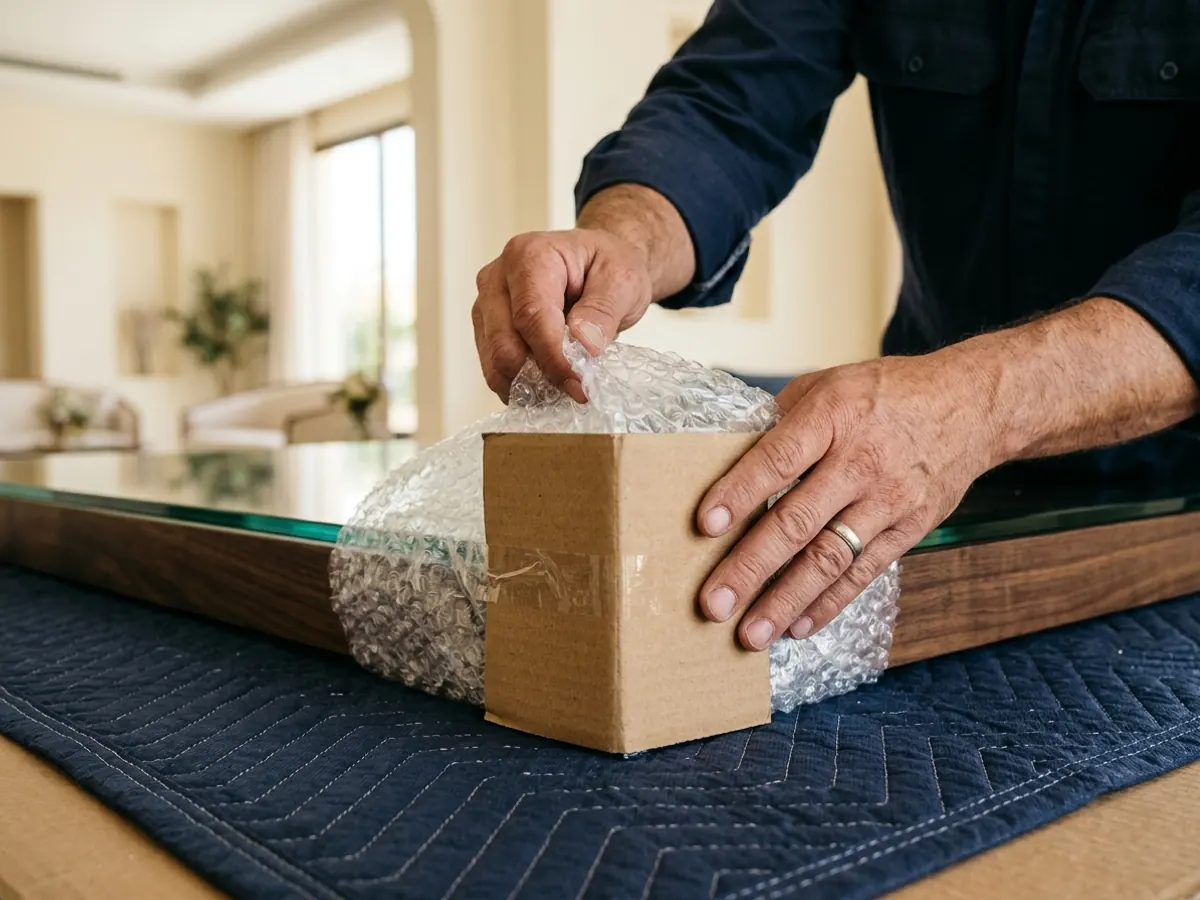
How is a piece’s risk assessed before it is protected?
Identify the material
Glass, polished wood, stone or mixed materials.
Measure the dimensions
The largest dimension and the surface thickness where possible.
Look for weak points
Edges, corners, joints and projecting parts.
Estimate scratch and break risk
What is affected by friction and what is affected by impact.
Set the securing needs
Upright or flat, and what is needed to hold it inside the vehicle.
When are the right materials used?
Soft materials
- A padded moving blanket for large surfaces
- Soft non-adhesive paper or film for polished finishes
- Bubble wrap for small pieces and edges
Supporting materials
- Cardboard corners and foam tubes for edges
- Rigid boards or double cardboard for flat areas
- Stretch film to hold layers without sticking to the surface
Cautions
- Do not put adhesive tape directly on glass or polished wood
- Do not use newspaper because its ink can transfer to the surface
- Not every material suits every piece
Placing, securing and delivering the pieces
What happens inside the vehicle matters as much as the wrapping. Fragile pieces are placed so they do not rub against each other or carry heavier furniture, and they are secured to stay put through braking and bends.
Coordination before pickup and delivery helps: who receives, where the piece goes and whether doors and corridors are open. On arrival the wrapping is checked before it is removed, and if damage appears, photographing it immediately makes any review easier.
The limits of what we say here
Good protection lowers risk without removing it, which is why we state plainly what is not promised.
- No promise that damage or scratches cannot occur in any case
- No single wrapping method is presented as suitable for every piece
- A rare or extremely delicate piece may need a specialised provider
- Insurance and liability terms have not been confirmed yet and should be asked about before any agreement
What affects the cost of moving fragile furniture?
No fixed prices are shown because each piece needs different protection.
- Piece sensitivity
- Its material and weak points.
- Dimensions
- Large panels need more material and support.
- Amount of wrapping
- The layers and materials required.
- Equipment
- What the piece needs for carrying and securing.
- Transport conditions
- Access, loading and delivery.
- Distance
- How far the pieces travel between pickup and delivery.
Get a quote after sending the details of the service you need.
Send the fragile piece details
Type, material, dimensions and a photo are enough for a review.
Inquire about fragile furniture moving
Select the pieces and state their material, size and protection needs. Tips for each type you choose appear as you go.
Common questions about fragile furniture moving
How does protecting glass differ from protecting wood?
Glass needs edge protection and support across the flat area because it cracks under pressure, whereas polished wood is at risk from friction and adhesive tape and needs a soft first layer. The method changes with the piece.
What information is needed about the piece?
Its type, material, dimensions and count, whether it has a frame or detachable parts, and both locations. Photos sent inside the chat speed up the review.
Does size affect the move?
Yes. The larger the piece, the more support, hands and care at doorways it needs. Very large pieces may need the special assessment described on the heavy furniture page.
What affects the wrapping?
The material and size of the piece, its weak points, the length of the journey and the way it is loaded. These decide the materials and layers required.
Are all protective materials suitable for every piece?
No. Some materials harm some surfaces, such as adhesive tape on polished wood or newspaper on light surfaces. The choice of material follows the piece.
Is there a separate page for glass and mirrors?
No, they are covered here because protection in both cases is an assessment of material and size, and the research did not justify splitting them. A dedicated section for them is on this page.
Ask about protecting your piece
Send the inquiry and the suitable protection will be reviewed.
Related services you may need
Helpful guides before you enquire
- Packing furniture for movingLearn what bubble wrap, stretch film, moving blankets, cardboard and corner protectors are for, how to prepare wood, sofas, mattresses and glass, and the packing mistakes to avoid.
- Moving box types and usesA practical guide to choosing and organising moving boxes: matching carton size to item weight, reinforcing bottom seams, room colour-coding, and items never to pack.
- When a move needs assessmentWhen room counts are not enough for an accurate moving quote: heavy solid-wood pieces, marble and large mirrors, narrow stairs, walk-up floors, and how to measure access.