

Heavy and Oversized Furniture Moving in Najran
A big wardrobe, a heavy table or a huge majlis seat is not moved on guesswork. It starts with measuring and assessment: the piece’s size, approximate weight and whether it fits through the doors. Send the details and what is possible gets decided.
- Assessment before lifting
- Dimensions and access
- Do not lift it yourself
Illustrative AI-generated image, not an actual job by the company.
What decides whether a heavy piece of furniture can be moved?
It is a combination of factors, not weight alone: the piece’s three dimensions, its approximate weight, its shape and centre of gravity, whether it comes apart, the narrowest door or passage on its path, and the floor and elevator. After those are assessed, it is decided whether the move is possible and by what means.
This page does not promise to move any weight or size, and does not advertise cranes, hoists or special equipment. What is offered is an inquiry that is assessed after review, and the assessment may conclude that the piece needs a specialised provider.
- The three dimensions in centimetres
- Approximate weight if known
- Whether it can be taken apart
- The narrowest door or passage
- Floor and elevator
- Both locations and photos
What makes a piece hard to move?
- Size
Size
A piece larger than the entrance will not pass however light it is.
- Weight
Weight
It decides how many hands are needed and the way it is carried, and whether the floor and ramp can take it.
- Shape
Shape
Irregular pieces or ones with projections need more careful protection and securing.
- Balance
Centre of gravity
Tall, narrow pieces can tip when carried, so that is considered in how they are held.
- Take apart
Disassembly
Taking a piece apart can turn something that cannot pass into parts that can be carried.
- Surface
Surface sensitivity
Marble, glass and polished finishes need extra protection.
Safety first: do not lift a heavy piece alone
The risk of lifting must be assessed by people with the experience and means to do it. This page does not encourage any customer to lift or drag a heavy piece themselves.
- Do not lift a piece beyond your strength or one that needs more than one person
- Do not drag a heavy piece on stairs or a polished floor
- Do not stand under a piece or brace it with your body on a staircase
- Measure with a tape and photograph the piece instead of moving it to test the fit
- If the piece is unstable, keep children and pets away from it
Will the piece get through the door?
The width of the piece alone is not enough, because it needs a margin to tilt or turn at the doorway. Compare the largest dimension of the piece with the narrowest door or passage on its path, not only the front door.
The drawing is schematic and not to scale. If the piece does not pass with a comfortable margin, ask whether it can be taken apart before you consider any carrying method.
What to measure before sending the request
The piece
- Length, width and height in centimetres
- Approximate weight if it is on the label or in its manual
- Whether it has glass, marble or projecting parts
The route
- Width of the narrowest door or passage between the piece and the vehicle
- Stair width and number of turns
- Interior size of the elevator and the height of its door
What does “equipment” mean when moving large pieces?
Equipment is discussed here as general information only. Moving large pieces may involve tools such as hand trucks, carrying straps, ramps and protective blankets, and what is actually used depends on the piece and the site.
Mentioning these tools does not mean they are available within our service in every case; what is available is confirmed after assessment. Cranes and hoists are not offered on this page.
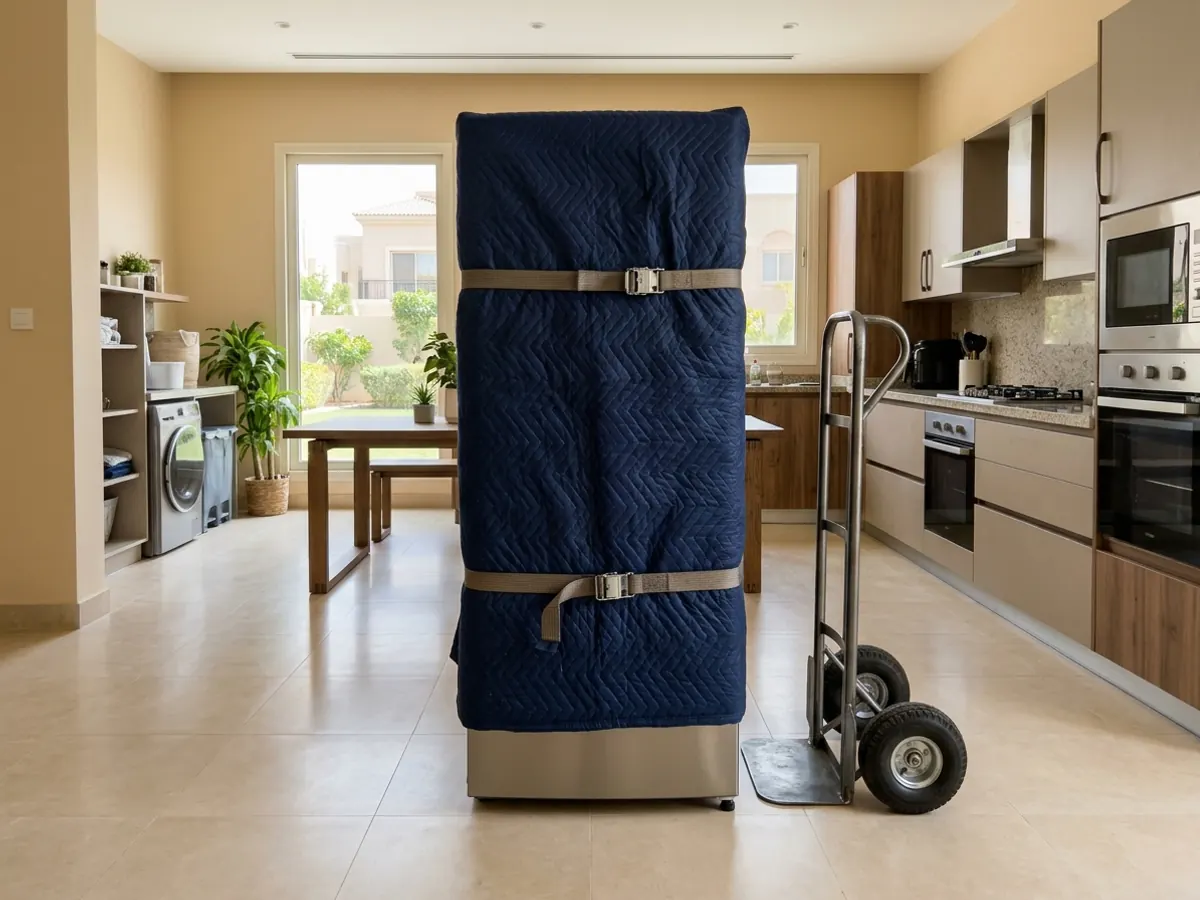
Protecting a large piece while it is carried
Edges and corners
Most damage happens at corners, so they are covered before any blanket goes on.
Surfaces
A polished or marble surface needs a soft non-adhesive layer first.
Glass
Glass parts are separated or supported and not left unprotected.
Joints and detachable parts
Doors and drawers are secured, and loose parts are gathered and labelled.
How does a heavy-piece request proceed?
An outline of the inquiry steps, not a promise of execution.
Send the details
Type, dimensions, weight if known and both locations.
Send photos
Inside the same chat: the piece, the entrance and the stairs.
Feasibility is assessed
Dimensions, access and whether it comes apart are reviewed, and more questions may follow.
What is possible is decided
The move may be possible under conditions, or it may call for a specialised provider.
What affects the cost of moving a heavy piece?
The cost of a heavy piece cannot be estimated before it is assessed, so no fixed prices are shown.
- Piece size
- Its largest dimensions and whether it comes apart.
- Approximate weight
- It affects the carrying method and how many people are needed.
- Access conditions
- Floor, elevator, stairs and the narrowest entrance.
- Equipment needed
- What the piece actually requires after assessment.
- Distance
- The route length between pickup and delivery.
- Number of people
- Set by the operational assessment, not by guessing.
Get a quote after sending the details of the service you need.
Send the piece details
Approximate dimensions and a photo of the piece are enough to start the assessment.
Send the furniture details for assessment
Enter the piece type, its dimensions and the narrowest door on its path, then send the summary and attach photos inside the chat.
Common questions about moving heavy furniture
Can any heavy piece be moved?
That cannot be stated before assessment. Feasibility depends on dimensions, weight, access and whether it comes apart, and a particular piece may need a specialised provider instead of an ordinary move.
Why do the dimensions matter?
They decide whether the piece passes doors, stairs and the elevator and whether it fits the vehicle. Send the longest measurement at least, then the width of the narrowest door on the path.
Does having an elevator matter?
Yes, but the elevator’s interior size and door height matter more than its mere existence. A long piece may not fit an ordinary elevator, so its dimensions are checked against the piece.
Can the piece be taken apart?
Some pieces are designed to come apart and some are not. That is decided once the type, brand and photos are known, and a piece is not dismantled before assessment so its joints are not weakened.
What information is needed for assessment?
The piece type, dimensions and approximate weight, whether it can be taken apart, the narrowest entrance on its path, floor and elevator, both locations, and photos sent inside the chat.
Should I lift the piece myself to test whether it fits?
No. Measure the piece and the doors with a tape and photograph them; do not try to lift or drag the piece to test its path, as this is among the most common causes of injury and damage.
Start by measuring the piece
Send the inquiry and what your piece needs will be reviewed.
Related services you may need
- Furniture movingWhen the piece is part of a larger move
- Single-item movingFor ordinary pieces that need no special assessment
- Appliance movingFor refrigerators and heavy appliances per the manufacturer’s guidance
- Furniture assemblyWhen disassembly decides whether the piece passes
- Fragile furniture movingFor large pieces with glass or marble surfaces
- Moving inside NajranHow to describe your location and what coverage is confirmed
Helpful guides before you enquire
- When a move needs assessmentWhen room counts are not enough for an accurate moving quote: heavy solid-wood pieces, marble and large mirrors, narrow stairs, walk-up floors, and how to measure access.
- Furniture inventory listA free tool to build an inventory of your furniture before a move: type, quantity, size, disassembly, packing and notes, with a readable summary, print and an option to send it as an enquiry.